The most expensive software project is the one you throw away.
Every company that's built something they later scrapped knows this feeling. Six months and $400K into a build, someone finally talks to an actual user and discovers the whole thing solves a problem nobody has. Or worse: it solves the right problem in a way that makes people's lives harder. The spec document was 40 pages long and nobody read past page six. The loudest person in the room picked the features. The engineers built exactly what they were told, which happened to be exactly the wrong thing.
This happens because most teams skip the hard part. They jump straight from "we need a product" to "let's start building." Or they run a design exercise that produces beautiful mockups nobody checked with a real user. Or they write requirements documents based on stakeholder assumptions instead of evidence.
The Product Design Sprint exists to close that gap. It's 2-4 weeks of structured discovery: talking to real users, testing real concepts, and evaluating real technical constraints. You walk away knowing what to build, why it matters, and how to build it. Not a 200-page document. A focused plan your team can start executing on Monday.
Human-Centered Agile: 15 years of learning how to build the right thing.
We didn't invent agile, and we didn't invent human-centered design. But we spent 15 years figuring out how to make them work together, because separately, they both fail. Agile without research builds the wrong thing efficiently. Research without delivery never ships. Together, they produce software that solves real problems and actually gets into people's hands.
Discovery
User interviews, research synthesis, and opportunity mapping. Understanding the real problem from the people who experience it.
Definition
Concept sketching, rapid prototyping, and user validation. Testing multiple approaches before committing to one.
Validation + Feasibility
User testing and design refinement running in parallel with technical feasibility and architecture planning. Everything orbits around user outcomes.
Every phase feeds insights back to the center: what does the user actually need? AI accelerates the mechanical work (transcription, synthesis, competitive analysis, and prototyping). The judgment calls stay human.
Three weeks. Research to roadmap. Here's what happens.
Most sprints land at three weeks. Some run two; a few stretch to four depending on research scope and organizational complexity. The rhythm is the same regardless.
Discovery: understand the problem before touching a wireframe
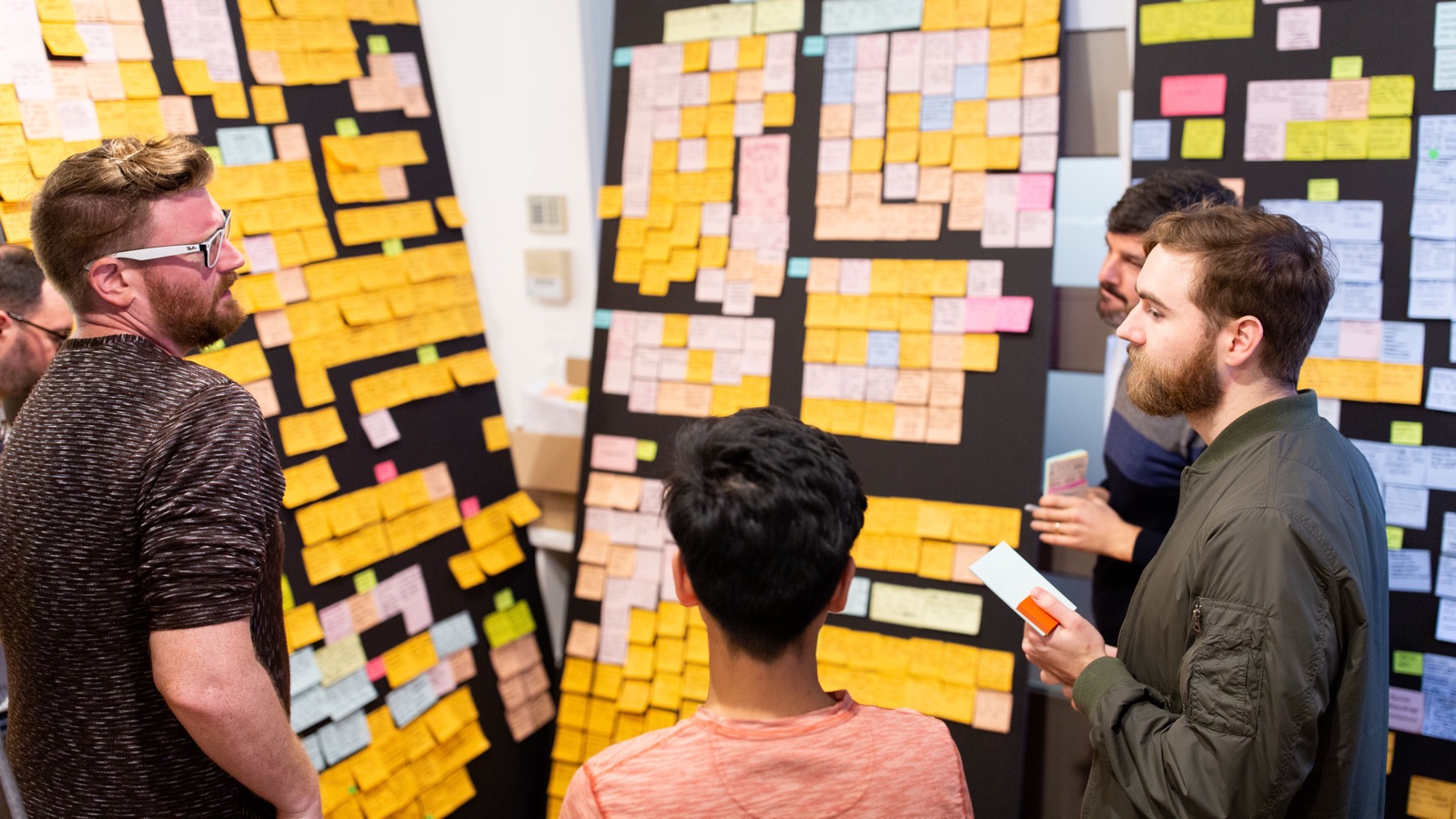
We start with people, not pixels. Your Conductor and a UX researcher conduct 6-10 user interviews and stakeholder sessions during the first week. These aren't surveys and they aren't assumption-validation exercises. They're open-ended conversations designed to surface the real problem, which is often different from the problem the project brief describes.
AI accelerates the mechanical parts: transcription, pattern extraction, and competitive landscape mapping. Your team spends time on insight generation instead of note-taking. By Friday, we've synthesized parallel research streams into themes, key insights, and a set of "how might we" statements that frame the design challenge.
Definition: sketch, prototype, and test with real users
Research insights become concepts. We brainstorm broadly first: multiple approaches to the same problem, each with different trade-offs. Then we narrow. The strongest two or three concepts become clickable prototypes, built fast enough to test but detailed enough to learn from.
By mid-week, we're putting prototypes in front of real users. Structured usability testing with scripted scenarios, not informal demos where someone nods politely while checking their phone. We test with the original research participants and fresh ones. The feedback is specific and actionable.
Validation + feasibility: can we build this, and what will it take?
Here's where MiT's sprint is different from a typical design sprint. Your Conductor isn't a designer who hands concepts to engineers and hopes for the best. They're a senior engineer-architect with 10-15+ years of production experience. While the design is refined based on user testing, the Conductor evaluates build complexity, identifies integration challenges, maps architecture options, and estimates timelines.
This runs in parallel, not in sequence. Design refinement and technical feasibility happen at the same time, informing each other. A concept that looks elegant but requires 18 months of infrastructure work gets reshaped early, before anyone's committed to it. The sprint ends with a presentation to your team: here's what we learned, here's what we recommend, here's the roadmap, and here's what it'll take.
Go: Build it
Research validates the concept. Users want it. It's technically feasible. The roadmap is clear. Move to Application Development with the same Conductor.
Pivot: Reshape it
The core problem is real, but the solution needs a different shape. The sprint identified the right direction. Another short cycle refines the concept before building.
Stop: Don't build it
Research shows the problem isn't big enough, or an existing solution does it better. You saved six figures and six months. That's a win.
A package your team can start building from. Not a shelf document.
Every deliverable is designed to be actionable. Your engineering team should be able to pick up the roadmap and start sprint planning. Your leadership team should be able to present the findings to a board. Nothing collects dust.
Research synthesis report
Themes, key insights, and evidence-backed findings from user and stakeholder research. Not interview transcripts. Distilled intelligence your team can act on, with the source data available for anyone who wants to go deeper.
Validated wireframes + prototype
Clickable prototype tested with real users. Not a polished Figma portfolio piece; a functional representation of the product concept that's been through usability testing and refined based on what users actually did, not what they said they'd do.
Technical feasibility assessment
Architecture options, technology stack recommendations, integration point mapping, risk identification, and build complexity analysis. Written by a senior engineer who's shipped production systems, not a designer guessing at technical constraints.
Prioritized product roadmap
A milestone-based plan connecting validated user needs to buildable increments. MVP definition, feature prioritization, and a recommended build sequence. This is the bridge between "we know what users need" and "here's how we ship it."
Clear scope. Fixed price. No surprises three weeks in.
Depends on research scope and organizational complexity. Most sprints land in the $50K-$60K range.
Three weeks is the sweet spot. Two for tightly scoped problems; four when research requires broader participant pools.
A senior engineer-architect leads the sprint alongside a dedicated UX researcher/designer. Both stay for the duration.
What happens next is the whole point.
The sprint's output is designed to feed directly into an Application Development or Data Engineering engagement. The Conductor who ran your sprint scopes and leads the build. Every insight, every architecture decision, and every piece of context carries forward.
One relationship. Continuous context. No handoff to strangers who ask you to re-explain everything you already spent three weeks discovering.
Not ready to build yet?
That's fine. The sprint deliverables stand on their own. Some clients use the roadmap to secure funding. Others bring it to their internal team. The research and feasibility assessment are yours regardless of what comes next.
Four situations where a sprint pays for itself before the build even starts.
Companies building a new product
You have a business idea or a strategic hypothesis, but you haven't validated it with users or figured out what to actually build. You need structured discovery before committing engineering resources. The sprint turns a hunch into a plan backed by evidence.
Organizations redesigning a critical application
The current system works, but it's painful. Users have workarounds for the workarounds. The backlog is a graveyard of half-baked feature requests. You need to step back and redesign from the user's perspective, not bolt on features. The sprint gives you permission to start from the problem instead of the existing UI.
PE portfolio companies post-acquisition
The operating partner has identified a technology product opportunity in the portfolio company. Before investing $500K+ in development, a $50K sprint validates the concept, defines the MVP, and produces a credible implementation plan for the board. It's insurance against building the wrong thing on someone else's timeline.
CTOs who need to align five people with five different visions
Everyone has an opinion about what the product should be. Nobody's talked to an actual user. The sprint creates a shared understanding of the real problem and a single validated direction that the whole leadership team can commit to. It's cheaper than building three different prototypes and arguing about which one to ship.
Great fit
- New product ideas that haven't been validated with real users yet
- Critical applications that need redesigning from the user's perspective
- PE portfolio companies validating a technology product opportunity before investing
- CTOs who need to align five stakeholders with five different visions around one plan
Not the right fit
- Teams that already have a validated product spec and just need developers
- Simple feature additions to existing products
- Projects with budgets under $40K for the discovery phase
- Organizations that want mockups without talking to real users