The office was never the point. The work was.
Here's a question nobody in consulting likes to ask out loud: if your best engineer is in Denver and your client is in Atlanta, what exactly does a Chicago office buy you? A lease payment. A conference room that sits empty four days a week. The vague reassurance that "the team is together," even when half of them are on client calls with headphones on.
We tried the office thing for years. Open floor plans, standing desks, and cold brew on tap. It was fun, but it wasn't honest. Our best work happened in focused, uninterrupted blocks. Architecture decisions got made on whiteboards, sure, but they got refined in Slack threads, pull request reviews, and shared documents over the days that followed. The office provided proximity. What we actually needed was intentionality.
So we made a choice. Not a pandemic pivot. A deliberate design decision, informed by 15 years of shipping software and a clear-eyed look at what actually makes consulting engagements succeed.
The answer, it turns out, isn't where you sit. It's how you communicate, how you document decisions, and whether your client can see what's happening at any given moment without scheduling a meeting to find out.
More transparency than an on-site team. That's not a typo.
The biggest fear clients have about remote consultants is losing visibility. "What are they actually doing all day?" Fair question. Here's our answer: you'll know more about what's happening on your project than you would if we were sitting in your office.
On-site consulting sells presence. We sell progress, and we make it visible in real time. Every decision, every design discussion, and every architectural choice gets documented. Nothing lives in a hallway conversation that nobody wrote down.
Shared Slack channel from day one
Your Conductor, your specialist engineers, and your internal team share a dedicated Slack channel. Questions get answered in minutes, not meetings. You're not waiting for a weekly status call to find out where things stand. You can see the conversation happening in real time, jump in when you want, or just watch the stream.
Live project board access
Linear, Jira, Notion, or whatever your team already uses. You see every task, every status change, and every pull request linked to a story. Not a summary from a project manager filtering the truth; the actual state of the work, updated as it happens. If you want to check on progress at 10 p.m. on a Tuesday, you can. No meeting required.
Daily async standups
Every morning, a short written or recorded update: what shipped yesterday, what's in progress today, and what's blocked. It takes five minutes to produce and thirty seconds to read. You always know the trajectory. And because it's written, you can reference it weeks later when someone asks "when did we decide to change that API?"
Weekly demos of working software
Every week, we show you what's running. Not slides. Not wireframes. Functional software you can click through, question, and redirect. This is where the real feedback happens, and it's where remote consulting earns its keep: recorded demos mean your stakeholders who missed the meeting can watch it on their own time.
Everything documented, nothing lost
Remote work forces decisions into writing. Architecture decisions, design rationale, and trade-off discussions: they all live in shared documents, not in someone's memory of a whiteboard session from three weeks ago. When the engagement ends, you inherit a searchable record of every choice that shaped the system. That documentation is an asset your team will use for years.
Direct access to your Conductor
No account managers filtering your messages. No project managers translating your priorities for the engineering team. You talk directly to the senior engineer-architect who owns the outcome. Same person, every day, and in the channel you already use. When you have a question, the person who can actually answer it is one message away.
Distributed doesn't mean disconnected.
Remote work has a real failure mode: people drift into silos, stop talking about anything other than work, and slowly lose the trust that makes collaboration feel easy. We've watched it happen at other firms. So we built systems to prevent it. Not mandatory fun. Not forced team-building exercises. Just the conditions that make genuine connection happen naturally.
Weekly check-ins
Every week, team members are randomly paired for a 30-minute conversation with no agenda. Coffee, hobbies, or whatever's on your mind. It sounds small. It's not. These calls are how you find out a colleague has the exact experience you need for a client problem, or that someone on the bench just finished a side project using the framework you're evaluating. Serendipity doesn't happen by accident in remote work. You have to design it.
In-person gatherings
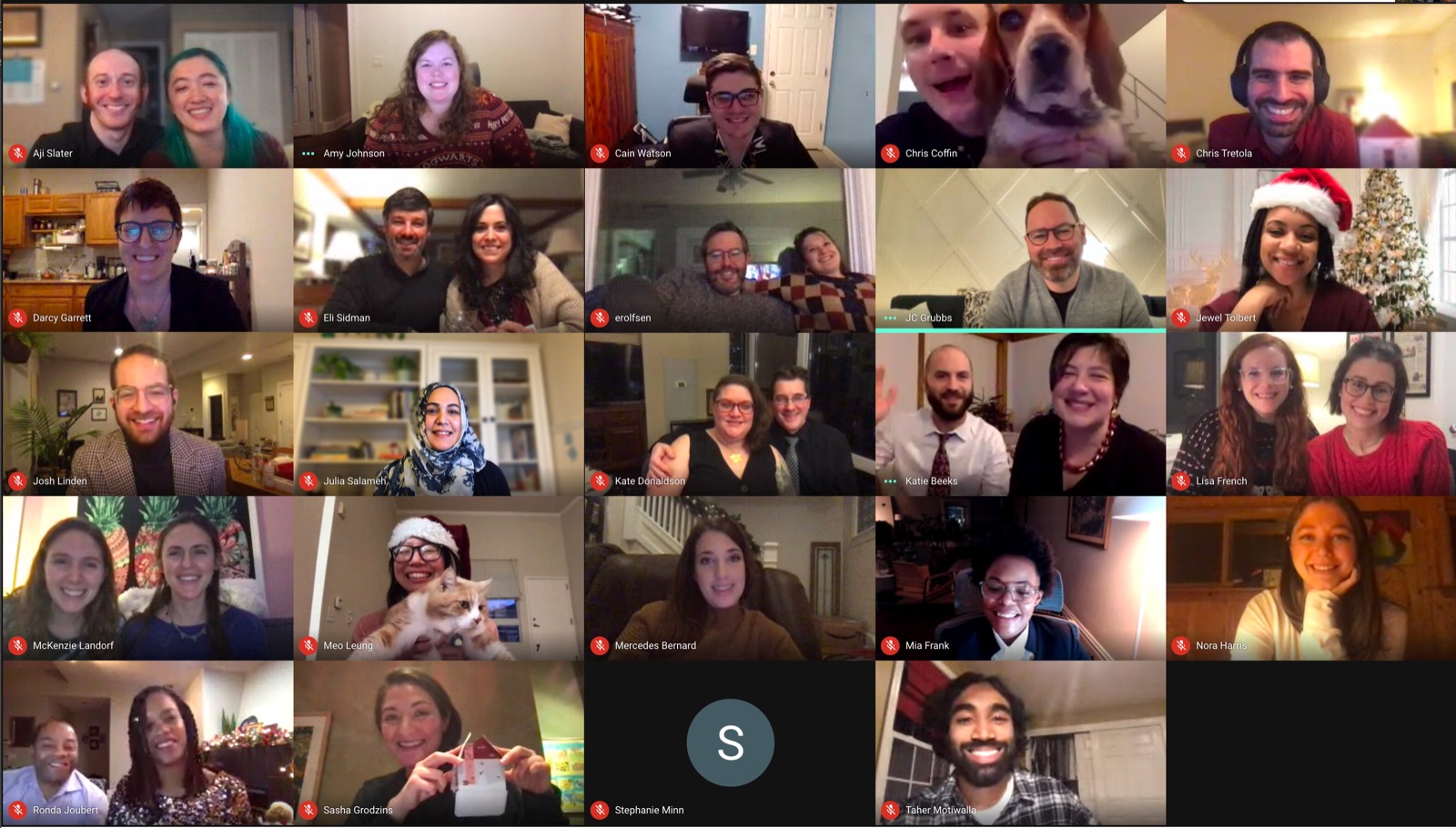
We get the whole team together in person (usually twice a year). Not for presentations or planning sessions (though some of that happens). Mostly for the things that remote can't do: dinners that run late, morning walks before sessions start, and the kind of unstructured time that turns colleagues into friends. We're honest about the trade-off. Remote gives us focus and flexibility. Face time gives us trust and memory. We need both.
Shared engineering culture
Internal tech talks, shared architecture review sessions, a running Slack channel for interesting problems, and code review across engagements when someone needs a second pair of eyes. The Conductor model helps here: because every engagement is led by a senior engineer-architect with deep judgment, the quality bar stays consistent without requiring physical oversight. Our people are senior enough to be trusted with autonomy. That's a prerequisite for remote work, and it's a prerequisite for being on our team.
Writing-first culture
If it matters, we write it down. Design proposals, architectural decisions, engagement retrospectives, and onboarding guides. Writing forces clarity in a way that verbal conversations don't. It creates a searchable institutional memory. And it means anyone on the team can get up to speed on any project without scheduling a "catch me up" meeting that eats an hour of someone's day.
You get the best person for the job. Not the closest one.
This is the argument that matters most to clients, even if it's not the one they ask about first. When geography doesn't constrain hiring, the talent calculus changes completely. We're not staffing your project from whoever lives within commuting distance of an office. We're choosing from the strongest senior engineers and data architects in the country.
Deeper specialization on every engagement
Need a senior data engineer with Snowflake and dbt experience who's also worked in healthcare compliance? An office-based firm hopes someone nearby fits. We find exactly the right person. Our curated engineer bench of 20-30 senior specialists spans time zones and specializations. When a project needs a specific skill, we staff that expertise within a week.
Senior people stay longer
Stanford's 2024 study found remote workers are 33% less likely to quit. For a consultancy built on senior talent, that's not a nice statistic; it's the whole ballgame. The Conductor who knows your business, your codebase, and your team's quirks doesn't leave because someone offered a slightly higher salary with a shorter commute. They stay because the work is interesting and the environment respects their autonomy.
Your budget goes to talent, not overhead
No downtown office lease. No travel expenses billed back to clients. No per diem for consultants flying to your city every Monday morning. Every dollar you spend with us goes to the people doing the work and the tools they use to do it. Office-based consultancies carry roughly $11,000 per consultant per year in overhead (Global Workplace Analytics). We'd rather put that money into hiring better engineers.
Time zone coverage, not time zone friction
A distributed team spread across US time zones means someone's always working during business hours, no matter where your stakeholders are. West Coast client with an East Coast deadline? A Conductor in Mountain time bridges the gap. We're thoughtful about scheduling overlap for synchronous collaboration, but we also take advantage of the fact that asynchronous work means progress doesn't stop when one person signs off.
Remote isn't perfect. Pretending otherwise would be dishonest.
We're not going to tell you distributed work is a silver bullet. It has real failure modes, and we'd rather name them than have you discover them on your own. The difference between a remote team that works and one that doesn't isn't the model itself. It's the systems built around it.
The challenge
Spontaneous whiteboarding is harder. The "hey, come look at this" moment that happens naturally in an office doesn't have a perfect remote equivalent.
How we handle it
Miro, Excalidraw, and Figma have made collaborative design remarkably good. Screen sharing with Tuple gives us pair programming that's as fluid as sitting side by side. But we won't pretend it's identical. For the rare engagement where co-location would genuinely help, like a two-day kickoff workshop or a complex discovery session, we'll travel. We're remote by default, not by dogma.
The challenge
Building trust takes longer when you can't read body language over lunch. Rapport that takes two weeks in an office might take four remotely.
How we handle it
We front-load trust-building. The first week of any engagement is heavy on video calls, often daily. Your Conductor shares their screen, walks through decisions in real time, and asks more questions than they answer. The cadence relaxes as trust develops, but we never let it disappear. Our Conductors are fluent in the skills that make remote relationships work: over-communicating context, writing clearly, responding quickly, and defaulting to transparency.
The challenge
Some clients are used to seeing their consultants in the building. There's a comfort in physical presence that remote can't replicate.
How we handle it
We replace the comfort of presence with the confidence of visibility. Shared Slack channels, live project boards, daily async updates, and bi-weekly demos. Within a month, most clients tell us they have more insight into what's happening than they've ever had with an on-site team. The measure of a good consulting relationship isn't whether you can see the engineers. It's whether you can see the progress.