When the data arrives a week late, the decision already got made.
The Climate Corporation's thesis is straightforward: agricultural yield improves when growers have better information at the moment they need to act. Acting on that thesis is the hard part. A row-crop operation covering tens of thousands of acres generates a torrent of data from planters, combines, weather stations, satellite imagery, and soil samples. Most of that data sits in formats that don't talk to each other, in systems that sync overnight at best, on screens that don't fit in a cab.
Our team contributed to the data engineering and mobile work behind Climate's farm performance platform. The goal wasn't to build another dashboard. It was to make field-level data useful in the middle of a 16-hour planting day, from the passenger seat of a tractor, without a Wi-Fi signal.
By the time we rolled off, the platform was surfacing real-time insights to more than 15,000 farmers across more than 40 million acres of U.S. farmland. What had been a reporting problem became a decision-support problem, and the decisions started getting made in time to matter.
Farming is high-variance. The data layer wasn't keeping up.
Every season, a grower makes thousands of decisions with incomplete information. When to plant. Which hybrid for which field. How much nitrogen, where. When to spray. When to harvest. Getting any of those wrong costs real money, and sometimes it costs the whole year. The data that could inform those calls already existed, scattered across half a dozen systems. Nothing was turning it into a coherent picture in time to act on it.
The raw material was abundant. Modern planters and combines stream telemetry continuously. Weather stations feed hyperlocal conditions by the minute. Satellite imagery captures crop health across whole counties. Soil sampling, as-applied maps, yield monitors — all of it generates data. The problem wasn't collection. It was ingestion, normalization, and delivery.
Different equipment vendors use different file formats, different coordinate systems, and different assumptions about what a "field" even is. A grower running a John Deere combine and a Case IH planter had data in two worlds that didn't reconcile cleanly. Overnight batch processing was the norm. By the time a yield map from yesterday's harvest made it into a grower's hands, the decision that map could have informed was already a day behind.
And then there was the last-mile problem: the people who needed this information the most weren't sitting at desks. They were in cabs, in fields, and at grain elevators, often miles from cell coverage. A web dashboard that assumed a stable connection and a full keyboard was the wrong answer. The right answer had to work on a phone, in a glove, at 5:30 a.m., and offline.
Four things we got right. One of them was not writing a dashboard first.
High-variance data and high-stakes decisions reward restraint in the early design work. We spent time understanding the grower's day before we committed to an architecture, and that ordering shaped everything that followed.
Field research with people in actual fields
Before scoping the platform, we spent time with growers and agronomists who would end up using it. Not interviews over video calls. In-person conversations during planting and harvest, watching how people actually use their phones while running equipment, what they need to see at a glance, and what they stop looking at the second it takes more than a second to load.
One finding shaped the entire mobile approach: the app had to work with dirty hands and a work glove. Tiny tap targets, swipes that required precision, any UI that assumed a clean touchscreen — all of it failed in the environment where it mattered. So we designed for the worst case first.
Ingestion built for high volume and high variance
The data pipeline had to handle formats from every major equipment vendor, weather sources streaming at different cadences, and imagery products with their own geospatial conventions. We built ingestion that normalized aggressively at the boundary, so downstream systems could treat a field as a field and a yield reading as a yield reading regardless of where it came from.
Just as important, we designed the pipeline to degrade gracefully. Partial data arriving late is still useful. Data arriving in the wrong order shouldn't break the view. Every stage of the pipeline assumed the input might be incomplete and had a defined behavior for what to show when that happened.
Mobile-first for people who don't work at desks
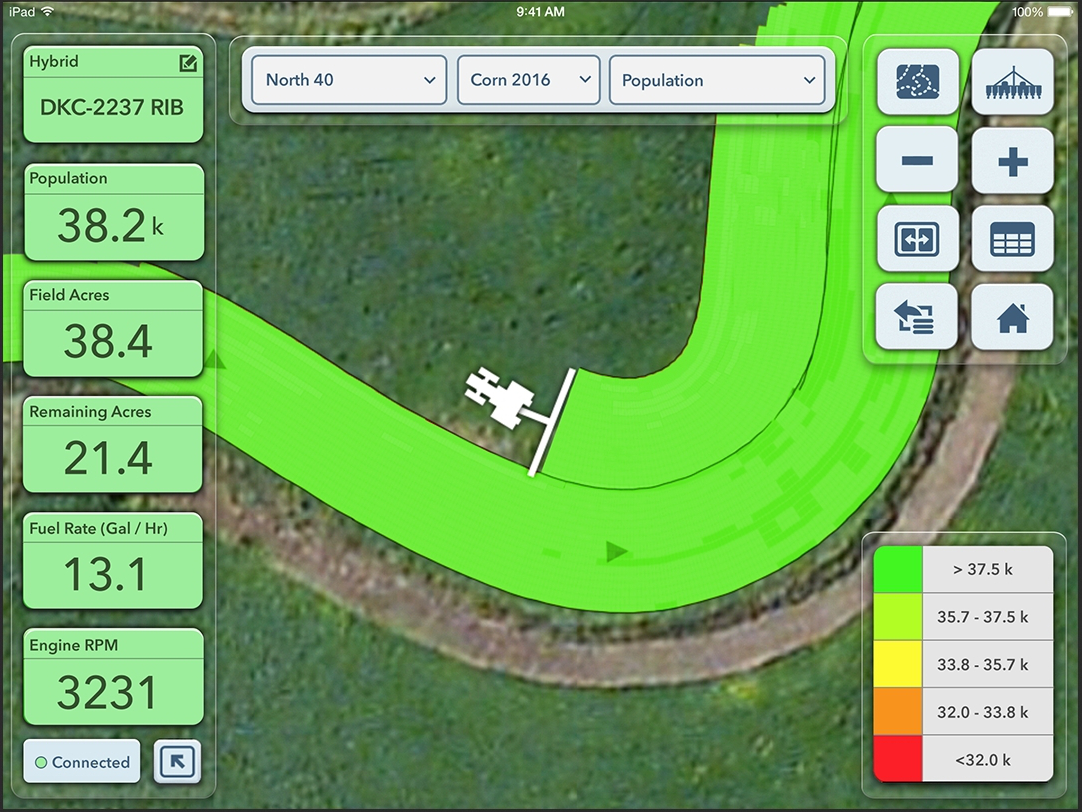
The mobile experience wasn't a companion to a web dashboard. It was the product. Growers needed to pull up a specific field, see the conditions that mattered, and move on in under ten seconds. We built the mobile client around offline-first data access, aggressive caching, and a single-screen view of what was happening right now in the field the user was standing in.
Connectivity in rural America is unreliable by default. We treated that as a design constraint rather than an edge case. The app had to work on the edge of a cell tower's range, on the side of a gravel road, with one bar.
Scale without theatrics
Moving from a pilot to tens of millions of acres is where most ag-tech platforms stall. The bottleneck is rarely compute; it's the long tail of data quality, schema drift, and the one vendor who changed a CSV format without telling anyone. We spent as much time on observability and data quality checks as on the features growers interacted with directly, so the platform could keep running when the inputs went sideways.
By the time the platform was in the hands of thousands of farmers, it was still the same codebase we started with. No heroic rewrite, no "v2 moment." Just the patient work of making each layer of the system boring enough to ignore.
FieldView platform architecture
Equipment-mounted IoT ingests real-time telemetry from any major vendor's planter, combine, or sprayer. The cloud platform normalizes it, joins external feeds, and returns field-level decisions to a grower's phone — all before the next pass.
The data stopped being late. The decisions started arriving on time.
The platform we helped build is running across a meaningful share of U.S. row-crop acreage. Here's what changed for the people using it.
The number that matters most isn't on this list. It's the number of decisions that got made on better information, in time to affect the outcome. A grower who sees a soil moisture reading before deciding whether to plant a given field isn't running a different operation than the grower a decade ago. The operation is the same. The inputs to the decision are sharper, and the decision happens a day earlier. Over a growing season, that compounds.
The less glamorous win was operational. The platform ran quietly, at scale, on boring infrastructure, with alerting that caught data quality issues before growers did. That's the kind of reliability you only notice when it's missing, and it's what let the product team keep shipping features instead of firefighting.