
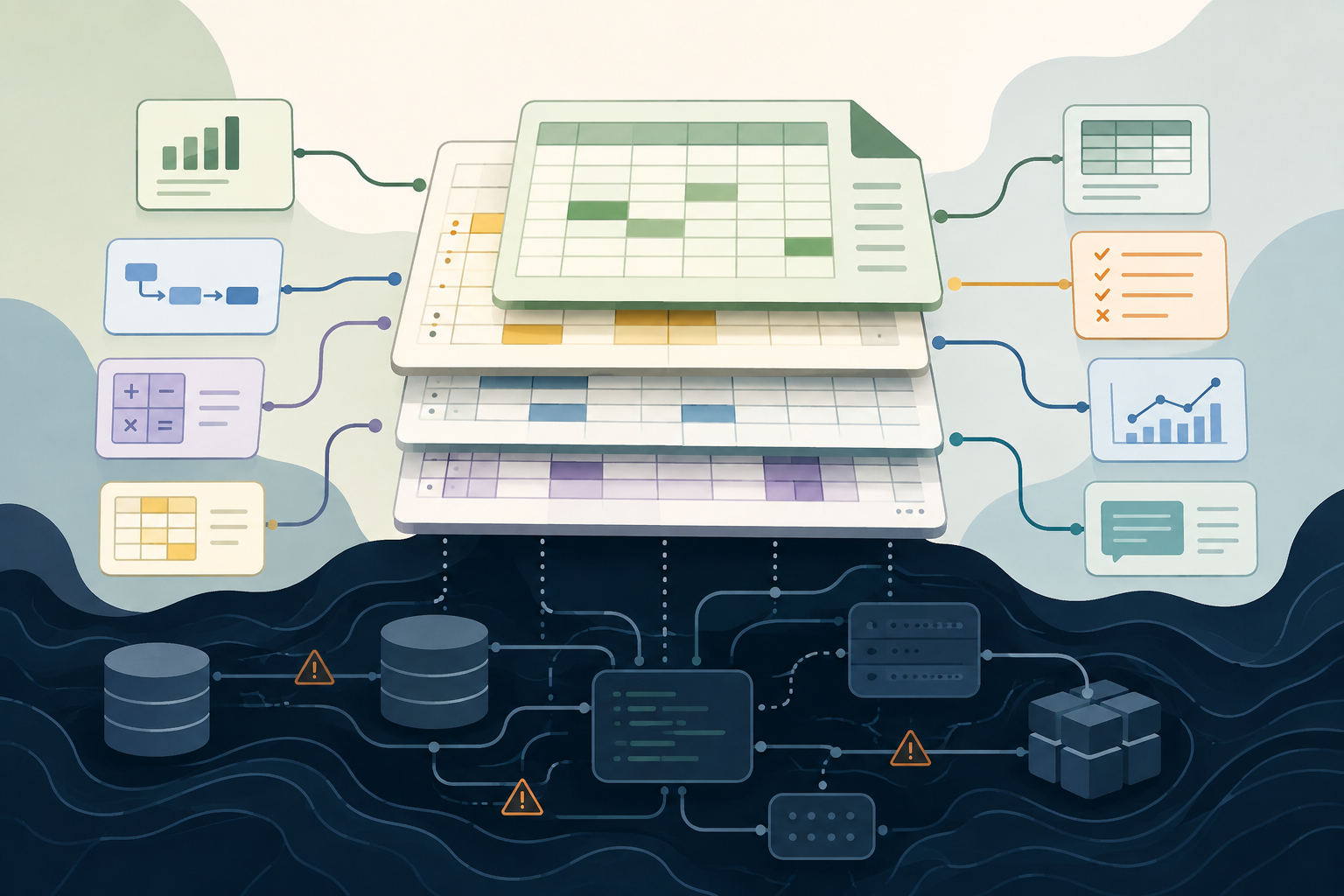
On a laptop, somewhere in your company right now, there's a file with a name like Q3_Margin_ACTUAL_v11.xlsx. It is copied as a template every quarter, opened every morning around 7:40. It has 14 tabs, only 2 of which matter, and a formula in column AH that exactly one person can explain. The finance team publicly distrusts it and privately consults it on the reg. If it evaporated tonight, tomorrow’s meeting would be a disaster.
Every company has these files. The usual response from leadership vacillates between intentional ignorance of them and declaring war on them. Solutions often lean towards a new BI rollout, or a "single source of truth" initiative, with a policy memo about unsanctioned tools and data locked on workstations. The files wage a quiet counter-offensive and survive every attack, because the files were never the problem. They are, however, an accurate map of it.
This architecture emerged; it wasn’t designed
A shadow spreadsheet is not an act of rebellion or control. It's what a capable person builds when the sanctioned systems can't reliably answer the questions their job depends on. The ERP can't join customer data across divisions, so someone joins it by hand. The official report takes 3 weeks to move through the BI backlog, but the answer is needed Friday. Each file is a rational response to a real gap. There was no screw-up that created the gap; the business simply outpaced its systems, which is what good businesses do.
But notice what the builder of that file actually did. They identified a requirement, designed a solution, shipped it, and have maintained it in production ever since, unnoticed, with an SLA enforced by their own deadlines. This may be one of the most accurate requirements documents your company owns, and it didn't come out of a discovery workshop. It's sitting in a shared drive, kept ruthlessly current, because someone's job depends on it being correct.
A field guide to the spreadsheet layer
The files are testimony and each archetype tells you something different.
The reconciliation sheet pulls from 2 systems that disagree and assembles one defensible set of numbers, by hand, every week. It marks an integration gap, and it costs you in hours and re-keyed errors. When people say "our data is bad," this file is usually where the badness gets laundered into something usable.
The tracker holds orders, claims, candidates, whatever moves through stages, in a matrix that mirrors how the work actually flows. It exists because the official system models how the work was supposed to flow 2 process changes ago, or the business never really adopted the workflow the tools wanted. It marks a workflow nobody modeled, documented, and built.
The rules sheet computes pricing, commissions, or exceptions. It's a rules engine with one maintainer, no version control, and perfect accuracy, because the maintainer’s head is where the rules actually live. It marks business logic that no owned system has ever captured. It's also the file that keeps running for a decade, because the logic was right even when its container was fragile and inaccessible.
The re-report starts life as an export from the official BI tool, then gets adjusted, and adjusted, and adjusted. Somewhere in its lineage is a filename with FINAL applied twice. It marks the exact place where trust in the official data died, and if you're lucky, a comment on a cell buried somewhere deep in the file gives the reason.
How a file becomes structural support
The lifecycle that results in these shadow documents runs quietly. A one-off answer gets a second tab. That second tab gets emailed weekly. The weekly email acquires a macro, then a distribution list, then a successor-in-training, and one unexpected quarter it appears in the board pack without provenance. No single step looked like an architecture decision. That's how architecture happens when nobody's deciding. By the time anyone notices, the file has seniority.
Your agents are about to read these files
For years the spreadsheet layer was a quiet tax: some hours, some risk, one bad week whenever a maintainer took vacation. AI agents change the economics of this underworld. Point an agent at your sanctioned systems and it gets the official data minus every correction the files exist to apply. Point it at the files instead and it gets the numbers but not the folklore, the column everyone ignores, the row that's always wrong in week 1 of a quarter, the reason the override exists, the second spreadsheet that is copy-pasted every month to reset.
But it’s hard for the people who built bridges over these gaps to carry agents across as well. Whatever the files and their keepers know has to land somewhere with an owner, a timestamp, a source attached, or the agents will learn the business from documents that only work when a human is whispering in their ear.
Understand them before you replace them
Don't start with a ban; that’s just an invitation for unrest and further subterfuge. Start with an inventory that rewards the maintainers of shadow files for their ingenuity. Find the 3 most important spreadsheets in the company and ask why each one exists. Ask the keepers, not their managers. And, ask it with genuine curiosity because every answer is a requirement somebody already validated in prod.
Then retire the files properly. Every load-bearing spreadsheet deserves an exit interview: sit with its keeper and extract what it knows, the joins it performs, the rules it encodes, the corrections it applies. Then, build the boring, owned, monitored version of that thing.
Retire the file when, and only when, what it was doing fully exists somewhere else. And, don’t let the keeper get displaced in the process; they get promoted to owner of the real version, which is only fair; they've been operating it by hand for years.
A war on spreadsheets fails because it confuses the map with the enemy. Explore the layer instead and you’ll uncover a prioritized backlog written by the people closest to the work, validated daily, and delivered free. Few companies can say that about any transformation initiative that came top down.
Our free Integration and Data Maturity Index asks a version of these questions across your whole data and integration picture. Just takes about 10 minutes: https://madeintandem.com/assessments/integration-and-data-maturity-index/